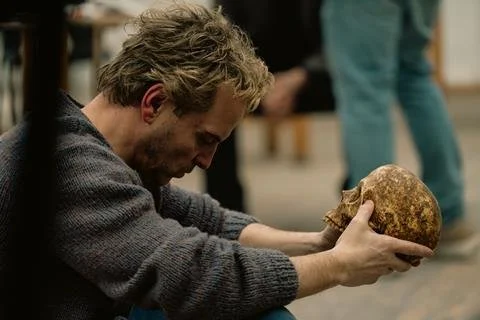
Andrew Scott in Elsinore (2026)
Andrew Scott has long been a favourite in my household. My husband’s favourite actor bar none. We were lucky enough to attend The London Film Festival’s screening of Elsinore at the Glasgow Film Theatre in October and this week the film was released in the United States with a UK release on January 29 2027 on the horizon. With that American release, Stefan Gregory’s score for the film has been released - I have eagerly been anticipating it since that evening in October.
Elsinore follows the true story of Ian Charleson (Andrew Scott) who was an actor famed for his role in Chariots of Fire who in 1989 won a return to the stage at the National Theatre playing the role of Hamlet. Sadly, this coincided with his diagnosis with AIDS - the film follows his desire to take to the stage as Hamlet and living the remaining time he has to the fullest doing the thing he loves the most and playing the role he has long coveted. We follow his treatment with his doctor Margaret Johnson (Olivia Coleman) and the steadfast support he receives from best friend Pasty Pollock (Billie Piper) as he works towards his first performance as Hamlet on the greatest stage of all.
Gregory’s score is sublime and it’s been a long wait to be able to listen to it in isolation - but from that first play, it’s more than been worth the wait. The album starts with the delicate In Search of a Miracle, a beautiful and understated piano piece which aches with pathos and sadness. The solo piano ensures that it holds the listener and never overplays that emotion. The delicate nature is wonderful, the idea of less is more in musical form. It’s also a warning of the emotional onslaught (the highest compliment!) both the film and the score will be moving forward. The following track The National is a sweeping orchestral piece, all classic and very British sounding strings with a swifter piano motif than the previous track, they quickly combine (at around 1 minute into the track) to create something that quickly envelopes you in the grandeur of the National Theatre and Charleson’s awe at the mere opportunity to tread those boards. The music acts as a conduit for Charleson’s emotional connection with both the theatre and the part and really helps the audience to connect with the character - the music is so very important here as it is easier to sympathise with a character facing a tragic medical diagnosis but the film hinges on the audience understanding his desire to play Hamlet and rooting for him in that regard. Gregory’s music, especially this track, is essential to building that understanding and audience connection early in the film.
No More Talk of Death is the first extended track on the album at 4.29 and scores Charleson coming to terms with both his diagnosis but also reconciling that with his unwavering commitment to the role of Hamlet. Gregory slows down that wonderful theme introduced in The National and allows it to slowly build over the extended piece of music. That piano motif highlighting Charleson’s passion for the play and then the complimentary strings and cello adding pomp and strength and a robustness to the track that perfectly captures the courage of the character to refuse a death sentence and to live doing the thing he most wants to do. It’s further powerful orchestration and the track build to a near bombastic crescendo before pulling back for the concluding stretch of music with the piano slowing down to highlight the reality of the physical challenge facing Charleson.
The track Georgie is used to great effect in the film as Charleson processes the loss of a his friend in silence with only the score to compliment the raw emotion of Andrew Scott’s performance. Again, the piano takes centre stage in this piece and there is certainly a swiftness to it that I feel captures the reality of the situation facing Charleson and so many gay men in the 1980s becoming a reality. It’s not something that happens to other people, it has now infiltrated his life in a stark way and this piece’s unstoppable energy on the piano captures that, while never losing the pathos and tragedy that permeates much of this wonderful score. Later in the album - and the film - Charleson loses a former love which is captured in the track Derek. It acts as a brilliant musical counterpoint. As Charleson cradles Derek, offering him kindness and love in his final moments, Gregory’s score remains piano focused but slows things down. It is no longer the musical force of the reality hitting Charleson but the soft, sad and delicate now, it’s not coming, it’s the truth of the moment. And the music is a heartfelt and sad goodbye for a character consumed by fear and a desperation to know that he has been loved - it’s a heartbreaking combination of music and screen performance. The tracks Georgie and Derek act as wonderful companion pieces from a music perspective.

Stefan Gregory
Exeunt is a haunting piano piece which is so delicate that it feels like it could break. Using only the lightest of touches, the piece feels like fingers are only gracing the keys, it’s a wonderfully atmospheric and emotional piece of music that envelopes you in a significant way. Take Arms begins in a similarly subtle way with further delicate piano with just the slightest hint of something more substantial, but as the music scores Charleson’s commitment to rehearsing for his stage debut as Hamlet, the track swiftly turns to a jaunty piano riff that is full of energy and the merest hint of darkness within that energy. Gregory’s increasing speed on the piano highlighting just how far Charleson is pushing himself to be successful, with an underscore of lush strings providing body and warmth to the track, perhaps reflecting the wonderful support Charleson receives from those around him. In the closing minute of the piece, the piano find a more solid footing amongst the energy to signify Charleson’s drive and strength. It’s a piece that really stands out - music full of hope.
The album ends with two extended tracks, the first of which Call to Stage captures Charleson’s triumphant moments on the boards. Once again, it’s a lush combination of strings and piano full of warmth and pride. It’s achingly emotional and feels like a really cathartic piece of music, like a victory has been gained within the darkness. Gregory leans into a robust percussion to add further weight to the piece while keeping the piano - which feels like the musical motif for Charleson’s heart and soul - central to the emotional heft of the track. Like the opening track, he never over plays it - skillful music taking the audience with it.
However, I may run out of superlatives for the closing track Flights of Angels. Coupled with stunning performances from Andrew Scott, Olivia Colman and Billie Piper, the conclusion of the film is a performance and music powerhouse that will leave very few dry eyes in the cinema. The strings and cello dominate the opening of the piece as we witness the reception that Charleson receives from his fellow actors who are blown away by his performance before percussion tolls to suggest that the darkness is not far from consuming the newly crowned Hamlet. As death approaches, the film focuses on Charleson’s commitment to living rather than just accepting death - he fights against the looming darkness and this music is swirling and hopeful and triumphant for much of the piece. It feels like a battle between what is coming with swirling percussion and then the triumphant brass and strings and a choral vocal sound to highlight that though the darkness comes, it never robbed him of his hope and ambition and commitment to living on that stage. The final moments of the piece return to that subtle and delicate piano in a touching and moving conclusion to the score and the film.
Elsinore was a truly wonderful cinema experience and I have little doubt that Andrew Scott will be in line for all sorts of awards - he deserves them all. However, it was Stefan Gregory’s score that feels like the greatest gift; a composer I was unfortunately not particularly aware of but now one I am keen to hear more from. Elsinore’s score is rousing, emotive and achingly beautiful, whether you are are able to enjoy it with the film in the cinema currently or if you have to wait until January for that treat, it is music that more than stands on it’s own two feet beyond the film. I urge you to get lost in this score.